
Illustrative image
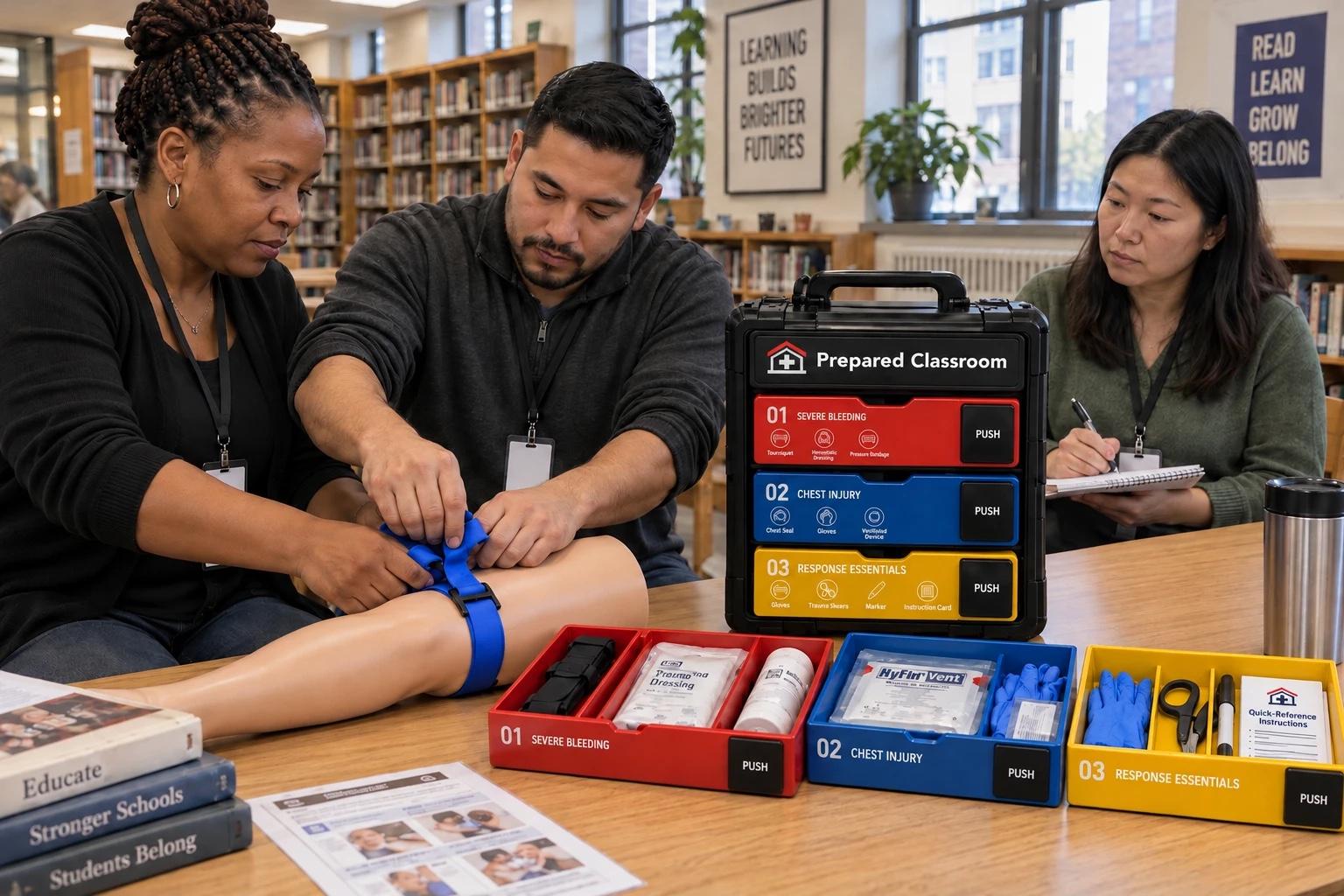
Two Hours That Could Save a Life
A hands-on training program that gives teachers the confidence and competence to act in the critical minutes before paramedics arrive. No prior medical experience required.
The training pathway in four stages
- Didactic
Understand
- Recognize severe bleeding
- Scene safety and activating help
- Kit layout, purposes and limits
- Age and size considerations
- Supervised practice
Rehearse the response
Bleeding control
- Direct pressure; tourniquet fit, including smaller limbs
- Appropriate wound packing and simple pressure dressings
- Gloves, splash protection and treatment documentation
Additional modules
- Vented chest seals with breathing reassessment
- Protective abdominal covering without abdominal packing
- Thermal protection and continued reassessment
Training equipment + observed skills checks
- Scenario
Work together under a clear plan
Open the kit, distribute pouches, report locations, and hand off to professional responders.
- Refresh
Retain skills and keep kits ready
Repeat practical skills; review school procedures. Check availability, packaging and expiry.
Course length and refresher timing are set locally with qualified instructors.
What Educators Learn
Module 1: Understanding Trauma Emergencies
- The leading causes of preventable trauma death
- Why response time determines survival
- The role of the educator as the true first responder
Module 2: Hemorrhage Control
- Tourniquet application (extremity bleeding)
- Wound packing with hemostatic gauze (junctional bleeding)
- Pressure bandage application
Module 3: Chest Seal Application
- Identifying a penetrating chest wound
- Applying the HyFin Vent chest seal
- Monitoring the patient
Module 4: Technology Integration & Scenario Practice
- How the IoT alert system works
- Full scenario walk-through with all kit components
- Timed practice under simulated stress
Our Approach
Aligned with national standards
Our curriculum includes and builds upon the American College of Surgeons' Stop the Bleed program. Participants who complete our training also meet Stop the Bleed certification requirements.
Designed for non-medical adults
Every technique is taught assuming zero medical background. We use plain language, step-by-step demonstration, and guided hands-on practice. If you can learn CPR, you can learn this.
Trauma-informed delivery
We recognize that this subject matter can be emotionally difficult. Our instructors are trained to deliver content with sensitivity, and participation is always voluntary. We focus on empowerment, not fear.
Tested under stress
Knowledge that isn't practiced under pressure doesn't hold. Our final module includes timed, scenario-based exercises that simulate real-world conditions — because muscle memory matters.
Training Formats
On-Site Seminar
RecommendedWe come to your school or district. 2 hours. All materials provided. Ideal for staff professional development days. Maximum 30 participants per session.
Train-the-Trainer
For districts that want to build internal capacity. We certify selected staff members to deliver the training independently. Includes instructor materials and ongoing support.
Conference & Event Sessions
Abbreviated or full-length sessions for education conferences, school board meetings, or community events. Customized to your audience and time constraints.
Annual Recertification
A 1-hour refresher course that keeps skills current. Includes updated protocols, hands-on practice, and recertification documentation.
Certification
Every participant who completes the training receives:
- Certificate of completion (Prepared Classroom Trauma Response Training)
- Wallet card for proof of certification
- Continuing education credit documentation (where applicable)
- Access to the annual recertification program
Frequently Asked Questions
Continue Reading
CARE Kits
The equipment educators learn to use — tourniquets, chest seals, and more.
Read moreResearch & Evidence
The military and civilian science proving that trained lay persons save lives.
Read moreSmart Technology
How opening a CARE Kit automatically alerts 911 with the exact room location.
Read more