
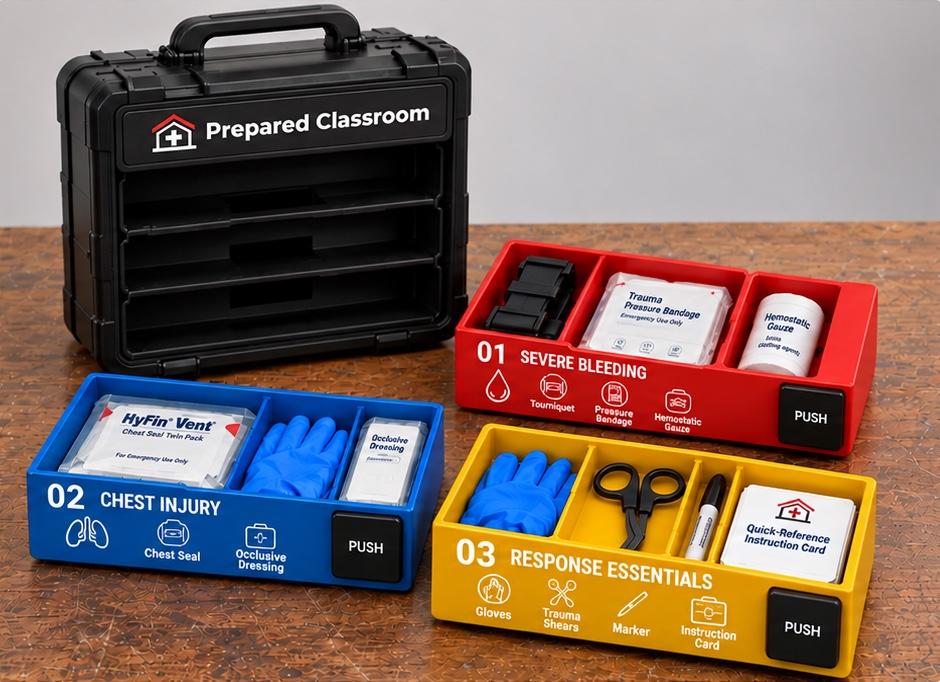
Illustrative image
Evidence-Based. Peer-Reviewed. Proven.
Every component of Prepared Classroom is built on decades of military and civilian trauma research. This is not experimental medicine. This is proven science applied to a new setting.
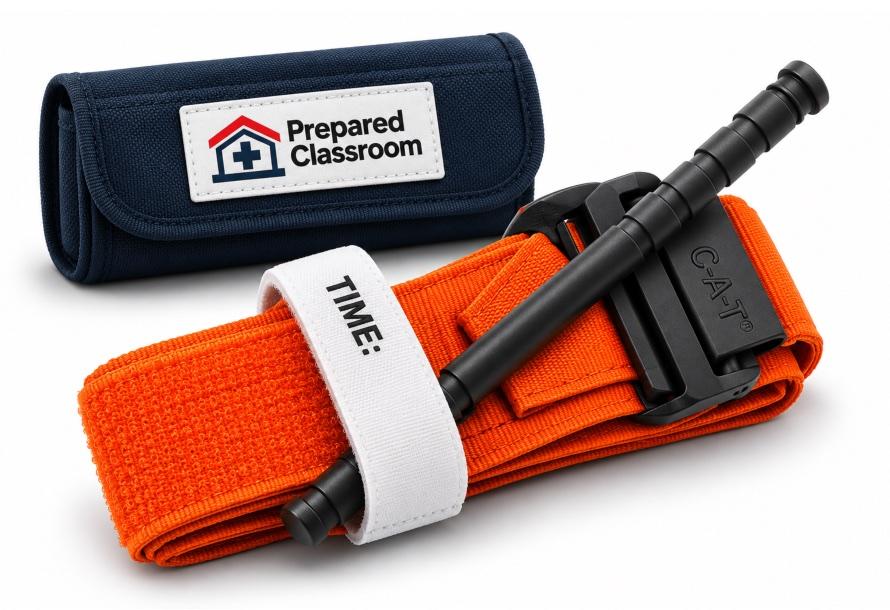
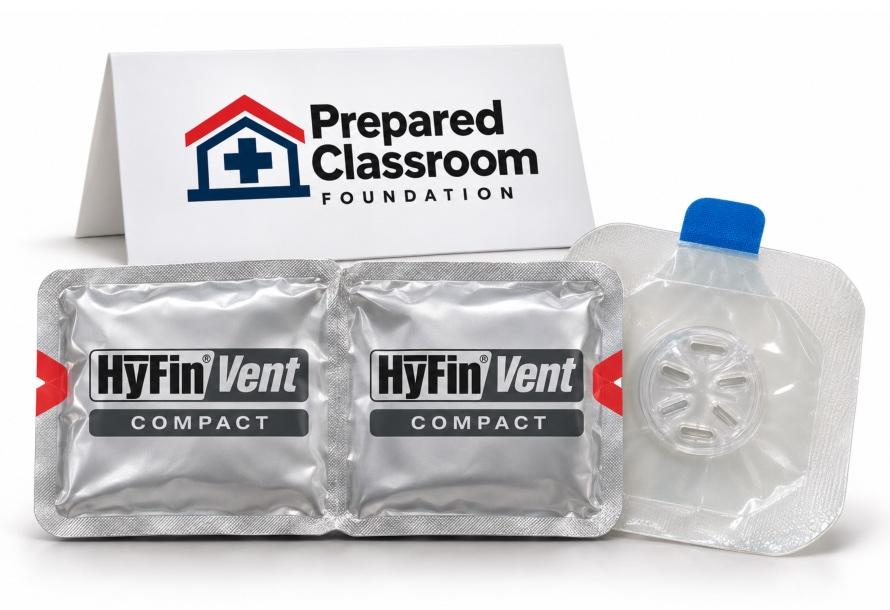
Tools proven in military and civilian trauma careIllustrative image
Military Medicine Foundation
The foundation of our program is Tactical Combat Casualty Care (TCCC), developed by the U.S. Department of Defense's Committee on Tactical Combat Casualty Care. TCCC establishes evidence-based guidelines for point-of-injury trauma care in combat.
Key findings:
- Before TCCC implementation, hemorrhage was the leading cause of preventable death on the battlefield — accounting for approximately 60% of preventable deaths.
- After TCCC was widely adopted, preventable combat deaths decreased by more than 50%.
- The most impactful single intervention was tourniquet application by non-medical personnel at the point of injury.
The critical insight: when trained individuals with basic equipment are present at the point of injury, survival rates increase dramatically — even when advanced medical care is delayed.
This finding transfers directly to the school context. The mechanism of injury differs, but the physiology of hemorrhage does not. A tourniquet stops bleeding whether the wound was caused by a bullet, a piece of shrapnel, or an industrial accident.
Civilian Trauma Data
The Hartford Consensus (2013–2015)
Following the Sandy Hook shooting, the American College of Surgeons convened the Hartford Consensus — a joint committee of medical, law enforcement, and emergency management experts. Their conclusion: “No one should die from uncontrolled bleeding.” This led directly to the national Stop the Bleed campaign.
Source: Jacobs LM, et al. Journal of the American College of Surgeons. 2014.
Stop the Bleed
Launched in 2015 by the American College of Surgeons and the Department of Homeland Security, Stop the Bleed has trained more than 5 million people in hemorrhage control. Early data shows that trained civilians can apply tourniquets as effectively as trained medical professionals.
Source: Goolsby C, et al. Journal of Trauma and Acute Care Surgery. 2019.
Tourniquet Efficacy
A study of 105 civilian patients found prehospital tourniquet use to be safe and appropriate, with a low rate of complications.
Lay-Person Intervention
Multiple studies confirm that non-medical individuals, with brief training, can correctly apply tourniquets, wound-packing gauze, and chest seals. The skills are simple, the equipment is intuitive, and the error rate decreases significantly with even minimal practice.
Key Statistics
Up to 20%
of deaths in active shooter events may be from potentially survivable hemorrhage
50%+
reduction in preventable combat deaths after TCCC implementation
5+ million
people trained through the American College of Surgeons' Stop the Bleed program
3–5 min
the window in which uncontrolled hemorrhage becomes fatal
30 sec
approximate time to apply a tourniquet with training
References
Every statistic on this website is sourced from the list below.
Statistics used on this site
- American College of Surgeons. “May Is National STOP THE BLEED® Month.” 2025. facs.org
- STOP THE BLEED® (American College of Surgeons / U.S. Department of Defense).
- New York State Education Department. Standard Response Protocol Operational Guidance.
- American Heart Association. 2024 American Heart Association and American Red Cross Guidelines for First Aid.
- Committee on Tactical Combat Casualty Care. Tactical Combat Casualty Care Guidelines: Tourniquet Application.
- Kotwal RS, et al. “Eliminating Preventable Death on the Battlefield.” Archives of Surgery. 2011.
Military & TCCC
- Butler FK, et al. “Tactical Combat Casualty Care: Transitioning Battlefield Lessons to Civilian Trauma Care.” Journal of Trauma and Acute Care Surgery. 2015.
- Eastridge BJ, et al. “Death on the Battlefield (2001-2011): Implications for the Future of Combat Casualty Care.” Journal of Trauma and Acute Care Surgery. 2012.
- Kotwal RS, et al. “The Effect of a Golden Hour Policy on the Morbidity and Mortality of Combat Casualties.” JAMA Surgery. 2016.
Civilian & Stop the Bleed
- Jacobs LM, et al. “The Hartford Consensus: A Call to Action for THREAT.” Journal of the American College of Surgeons. 2014.
- Goolsby C, et al. “Stop the Bleed Education Consortium: Education Spread and Impact.” Journal of Trauma and Acute Care Surgery. 2019.
- Scerbo MH, et al. “Safety and Appropriateness of Tourniquets in 105 Civilians.” Prehospital Emergency Care. 2016.
School Safety
- National Association of School Psychologists. “Rethinking School Safety: Communities and Schools Working Together.”
- Everytown for Gun Safety. “Gunfire on School Grounds.” Annual reports.
Continue Reading
The Problem
The response time gap and why schools need medical equipment in the classroom.
Read moreOur Solution
How we translate this evidence into a practical three-part program for schools.
Read moreTraining Program
The 2-hour hands-on course that teaches educators to use every item in the kit.
Read moreThe evidence is clear. The next step is action.