
Illustrative image
Medical Preparedness for Every Classroom
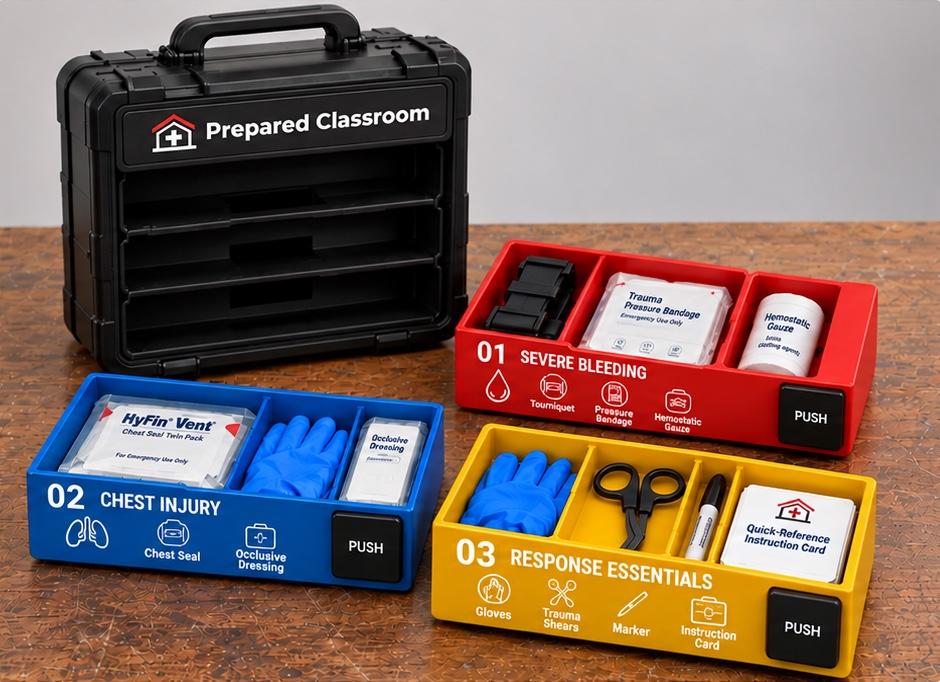
Three components. One mission. Close the gap between injury and professional medical response so that no one dies from a survivable injury because equipment wasn't in the room.
Illustrative image
How It Works — The Critical Minutes
Imagine a school emergency. Here's what happens with Prepared Classroom in place:
- 0:00
An emergency occurs.
A student or staff member is injured.
- 0:15
The trained educator acts.
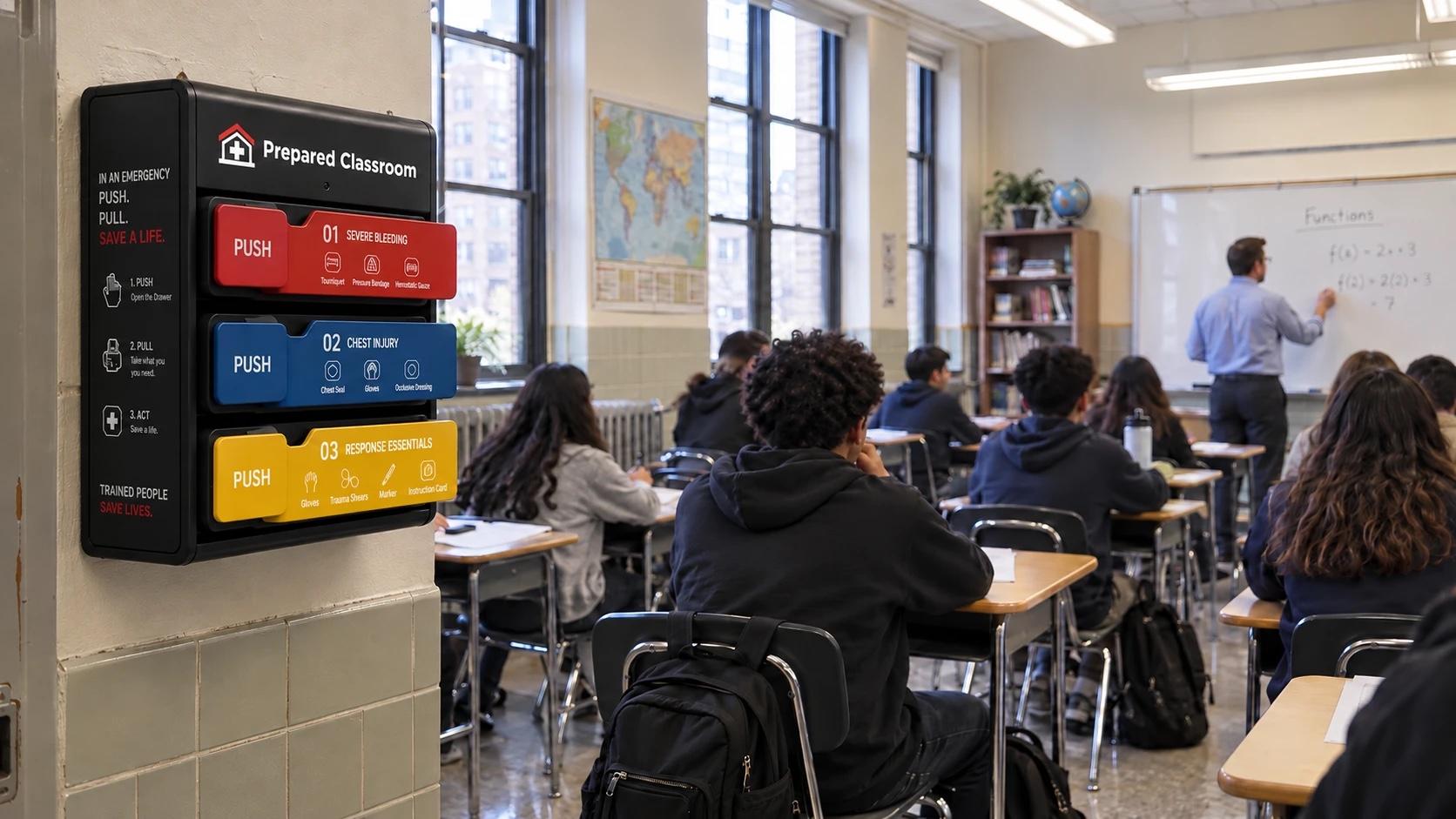
The teacher — already in the room — retrieves the CARE Kit from the wall. They have practiced this. They are ready.
- 0:20
Technology activates.
The moment the kit is opened, an IoT sensor sends an automatic alert to 911 dispatch with the exact building, floor, and room number. No phone call needed. No fumbling for a phone in a crisis.
- 0:30–2:00
Medical intervention begins.
The educator applies a tourniquet to stop extremity bleeding, or a chest seal over an open chest wound. These are the same interventions military medics use. They work.
- 2:00–5:00
The patient is stabilized.
Bleeding is controlled. The patient is alive. The clock is no longer the enemy.
- 7:00+
EMS arrives on scene.
When paramedics eventually enter the building, they find a stabilized patient. They have the exact location from the digital building map. No time wasted searching. They transport and begin advanced care.
The difference: Without Prepared Classroom, that patient receives zero medical care for 20–30 minutes or more. With it, they receive life-saving intervention within 30 seconds.
Three Pillars
CARE Kits — Equipment in Every Classroom
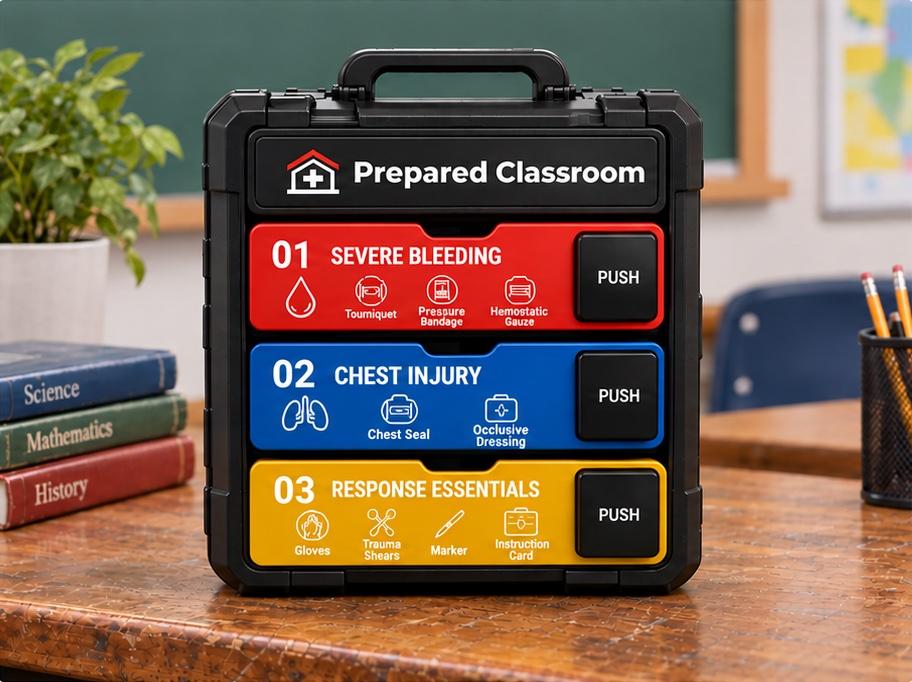
Purpose-built trauma kits designed for non-medical users. Wall-mounted, compact, and containing only the essentials: tourniquet, hemostatic dressing, pressure bandage, chest seal, gloves, trauma shears, and a quick-reference card. No medications, needles, or scalpels. Trauma shears are included to cut clothing. Think of it as the bleeding equivalent of an AED.
Learn more about CARE Kits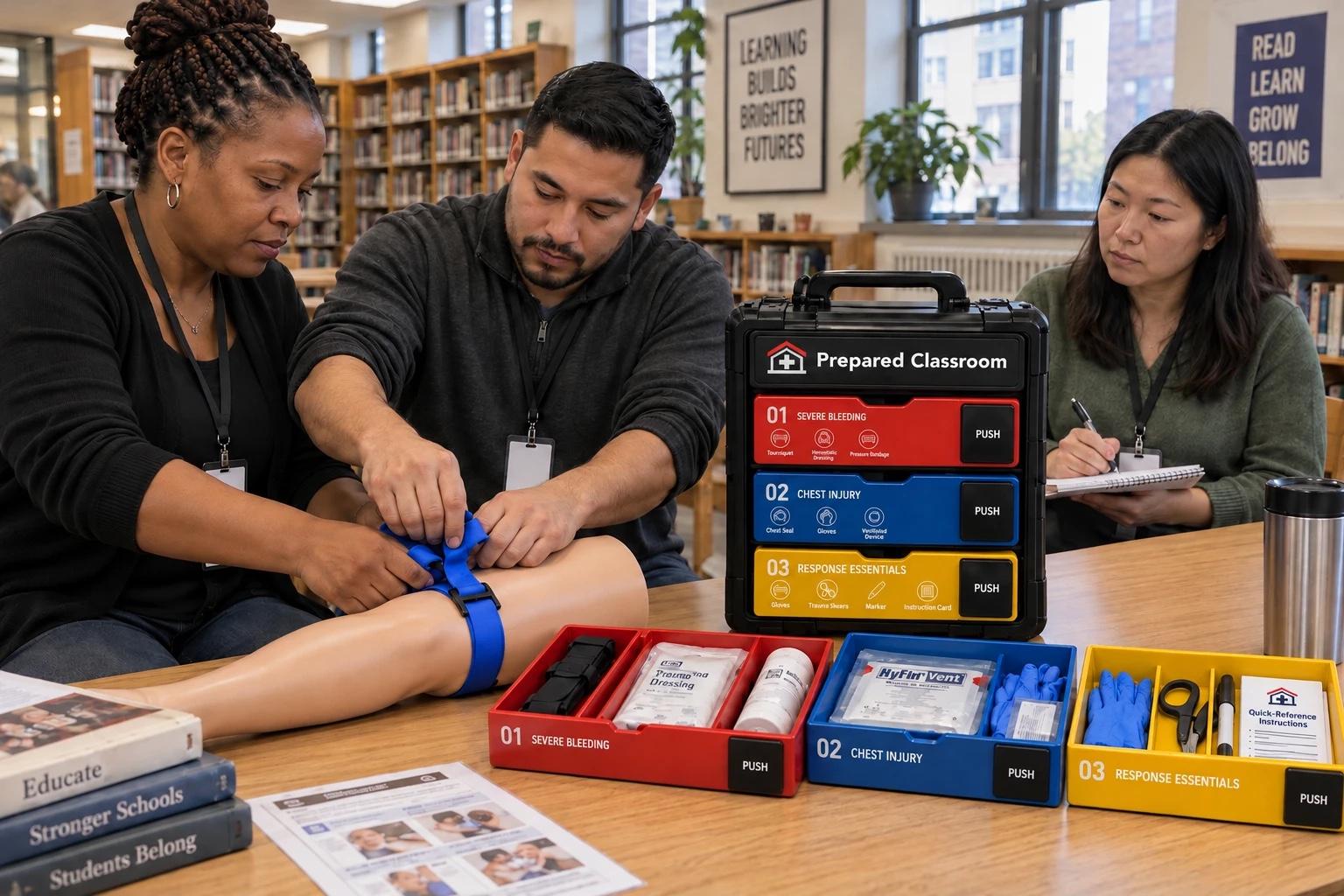
Educator Training — Confidence Through Competence
A 2-hour, hands-on training program. Teachers learn to apply every item in the kit through guided instruction and scenario-based practice. Aligned with Stop the Bleed (American College of Surgeons) and complementary to existing CPR certification. No prior medical experience required. Annual recertification keeps skills current.
See the Training Program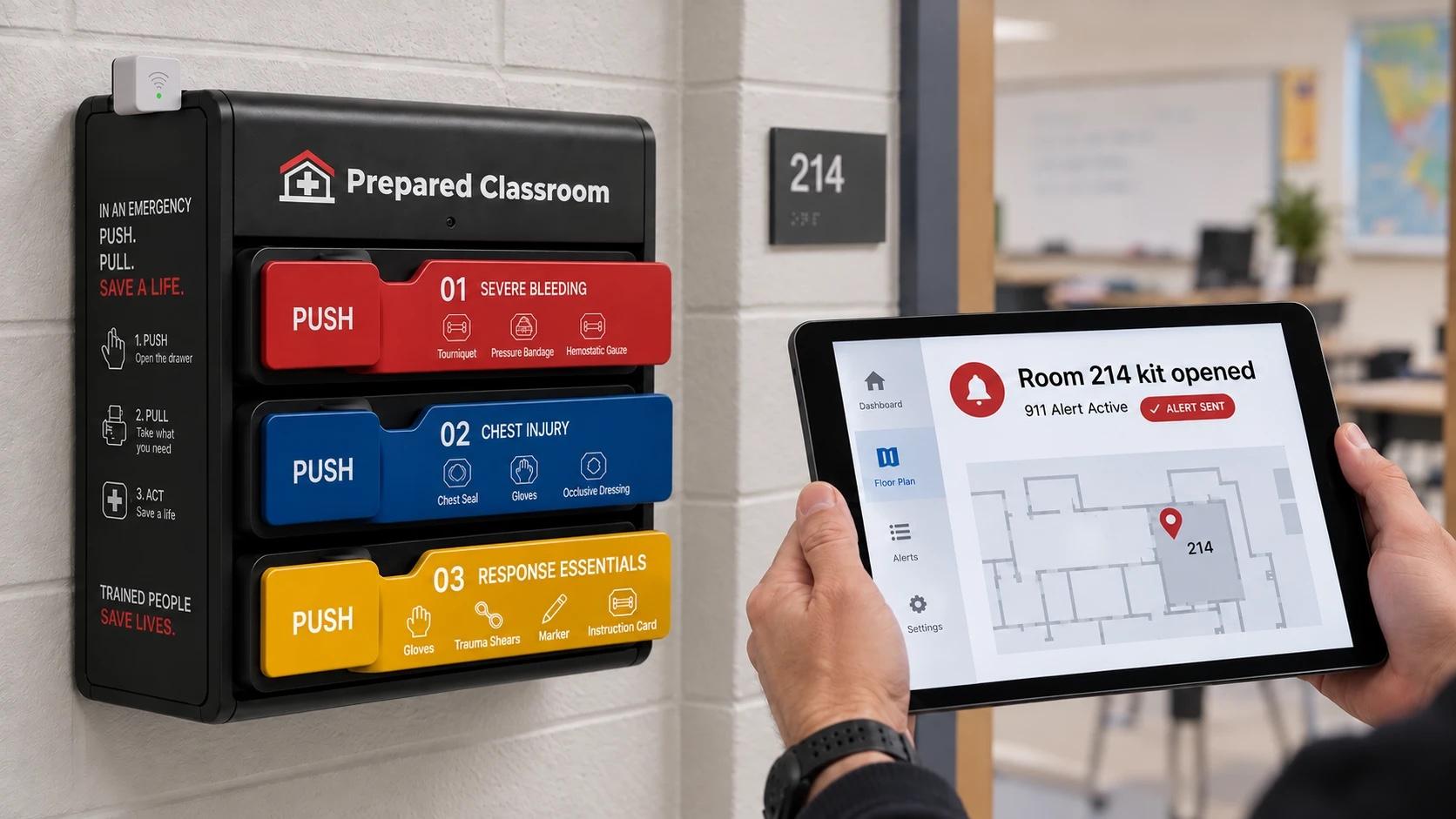
Smart Technology — Instant EMS Coordination
IoT sensors on each CARE Kit detect when it is opened and automatically notify 911 dispatch with the precise location — building, floor, room. A digital twin map of the school guides EMS to the patient. This eliminates the minutes lost to radio confusion and hallway searches. The kit is the alarm.
Explore the TechnologyWhy This Works
This is not a theoretical program. Every component is built on proven science.
- Tourniquets have been standard military equipment for 20+ years. Civilian adoption is accelerating through the Stop the Bleed campaign.
- Chest seals are carried by every military medic and increasingly by civilian first responders and law enforcement.
- Lay-person application of these devices has been studied extensively. Success rates are high. Complication rates are low.
87.5% Lower
Rate of potentially preventable deaths
A comprehensive battlefield casualty-response system incorporating Tactical Combat Casualty Care (TCCC) training was associated with an approximately 87.5% lower rate of potentially preventable deaths among the 75th Ranger Regiment compared with the broader U.S. military population.
We did not invent this medicine. We adapted it for schools.
Continue Reading
The Problem
Why the response time gap between injury and EMS arrival is the core issue in school emergencies.
Read moreResearch & Evidence
The peer-reviewed science and military data behind every component of this program.
Read moreCost Comparison
How medical preparedness compares to traditional school security in cost and effectiveness.
Read more