
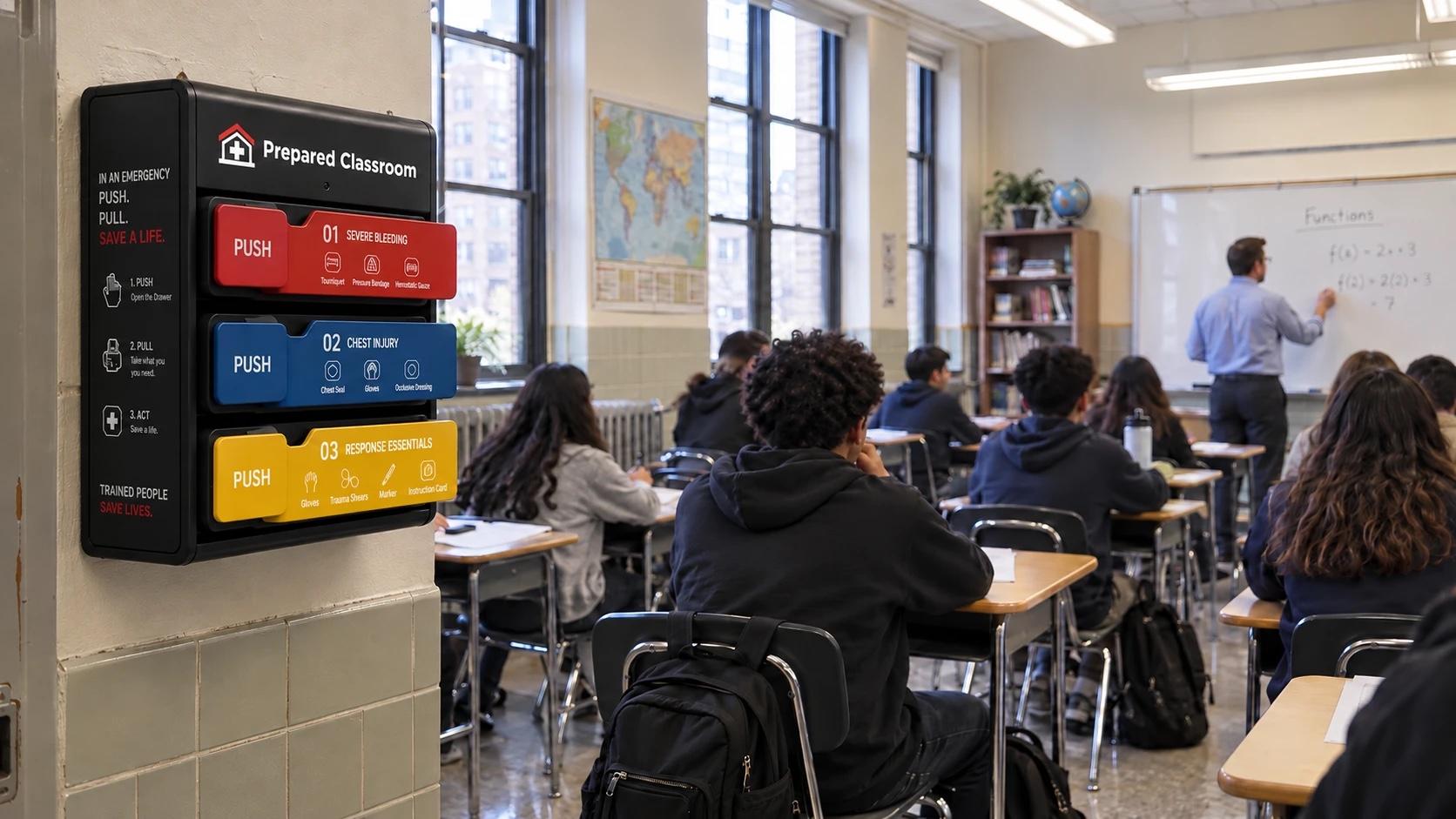
Illustrative image
The Response Time Gap
Most deaths in active shooter events are not caused by the severity of the injury. They are caused by the delay in medical care. This is a solvable problem.
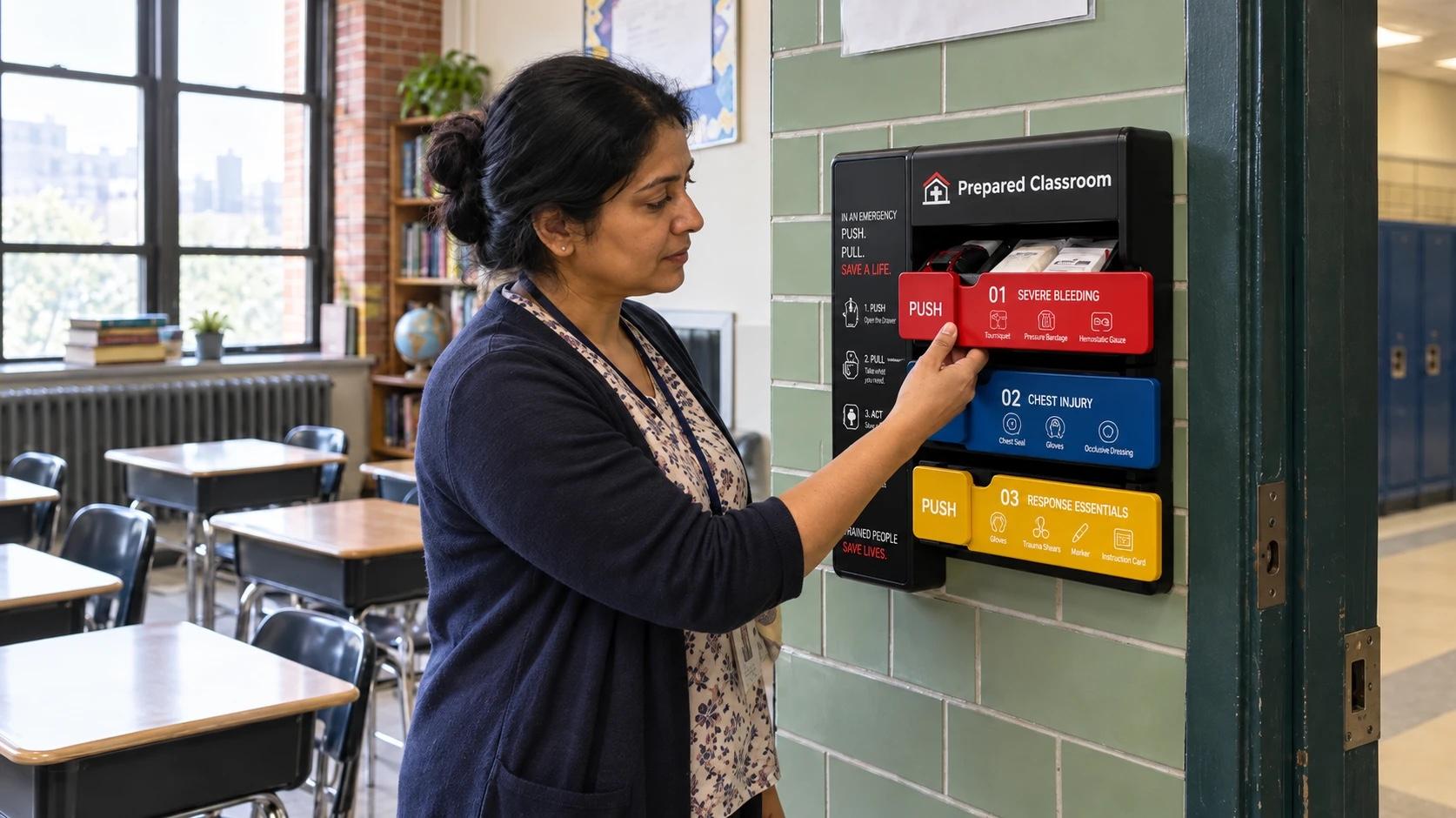
When EMS can't get in yet, the people already in the room respond.Illustrative image
Why Response Time Is Everything
When someone is shot, the clock starts immediately. Uncontrolled hemorrhage — the leading cause of preventable death in trauma — can kill in three to five minutes. The human body holds roughly five liters of blood. A major wound to the arm, leg, or groin can cause a person to lose enough blood to die in a matter of minutes. Not hours. Minutes.
Now, consider how a school emergency might unfold.
The moment of injury:
A student or staff member is wounded. The bleeding begins. The clock starts.
Within 1–3 minutes:
Someone calls 911. Depending on the school, this may be a teacher, an administrator, or an office staff member. In the chaos of an active emergency, this call may be delayed.
Within 5–8 minutes:
Police officers arrive on scene. Their first priority — correctly — is to neutralize the threat. They are not medics. They do not carry trauma equipment. They are focused on stopping the attacker.
Within 7–10 minutes:
EMS arrives in the area. Paramedics stage outside the building. They cannot enter.
Around 20–30 minutes after the first injury:
The building is declared clear. EMS enters. For some patients, this is too late. Not because their injuries were unsurvivable. Because no one in the room had the tools or training to stop the bleeding.
This is not a failure of first responders. It exists because sending unarmed medics into an uncleared building risks additional casualties. But the consequence is devastating.
This is the response time gap. And it is where the vast majority of preventable deaths occur.
The Data
The Department of Defense has studied this problem extensively — not in schools, but on the battlefield. The findings are directly transferable.
In combat, the same mechanisms kill the wounded: hemorrhage and chest injuries such as tension pneumothorax. When the military implemented a program called Tactical Combat Casualty Care (TCCC), which trained non-medical soldiers to apply tourniquets and chest seals, preventable combat deaths dropped by more than 50%.
The key insight: you don't need a doctor to stop the bleeding. You need a trained person with the right equipment, in the right place, at the right time.
In a school, that person is the teacher. They are already in the room. They already manage crises — fire drills, lockdown drills, severe weather protocols. They are the first adult present. They are, in every meaningful sense, the actual first responder.
But right now, in many schools, that teacher has no medical equipment and no trauma training. They can lock the door. They can shield students. They cannot stop a student from bleeding to death on the floor beside them.
What We're Missing
American schools spend billions each year on safety. Metal detectors, security cameras, locked entry systems, armed guards, threat assessment teams, run-hide-fight training. These are prevention and deterrence measures. They are important. But they address what happens before an incident. Almost nothing addresses what happens after.
Consider the analogy: every school has fire extinguishers. Not because we expect fires, but because when one happens, having equipment in the room is the difference between containment and catastrophe. We don't wait for the fire department. We act first.
We do the same with AEDs for cardiac emergencies. We do the same with EpiPens for allergic reactions. But for the most acute, time-sensitive medical emergency a school can face — traumatic hemorrhage — we have nothing in the classroom.
This is the gap. And it is what Prepared Classroom exists to close.
Why This Isn't Political
This is not a debate about gun policy. It is not a statement about gun control or gun rights. People across the entire political spectrum agree on one thing: when a child is injured, we should do everything possible to save their life.
Prepared Classroom is a medical preparedness program. It is based on evidence, not ideology. It uses the same equipment and protocols that have been standard in military medicine for two decades and are increasingly standard in civilian emergency response. It asks one question: if someone is injured in a school, is there equipment and training in the room to keep them alive?
Right now, the answer is almost always no. We believe it should always be yes.
Frequently Asked Questions
Continue Reading
Our Solution
Trauma kits, training, and smart technology — the three-part system designed to close this gap.
Read moreResearch & Evidence
Peer-reviewed studies and military data behind classroom trauma preparedness.
Read moreCARE Kits
What's inside the kit and how each item addresses a specific cause of preventable death.
Read moreThere is a solution. It is affordable. It is evidence-based. And it works.