
Illustrative image
Why Most School Shooting Deaths Are Medically Preventable
The Timeline Nobody Talks About
When most people think about school shootings, they think about prevention — how to stop the event from happening. That conversation is vital. But there is a second conversation that almost no one is having: what happens to the injured after the shooting starts?
The answer, in many schools, is: nothing. For 20 to 30 minutes or more, injured students and staff receive zero medical care. Not because help isn't coming — but because help can't get in.
The Response Time Gap
Here is how a school emergency might unfold:
- 0:00 — A student or staff member is injured. Bleeding begins.
- 1–3 minutes — Someone calls 911. In the chaos, this call may be delayed.
- 5–8 minutes — Police arrive. Their priority is neutralizing the threat, not medical care.
- 7–10 minutes — EMS stages outside the building. They cannot enter.
- 20–30+ minutes — Law enforcement clears the building. EMS finally enters.
During that entire window — from the moment of injury to the moment paramedics reach the patient — the injured receive no medical care. For hemorrhage victims, this delay is fatal. Not because their injuries are unsurvivable, but because no one in the room has the tools or training to stop the bleeding.
What the Military Taught Us
The U.S. Department of Defense faced this exact problem on the battlefield. Soldiers were dying from wounds that should have been survivable — primarily uncontrolled bleeding from extremities and collapsed lungs from chest wounds.
The military's solution was Tactical Combat Casualty Care (TCCC): train non-medical soldiers to apply tourniquets and chest seals at the point of injury. The result? Preventable combat deaths dropped by more than 50%.
The key insight was simple but profound: you don't need a doctor to stop the bleeding. You need a trained person with basic equipment, at the right place, at the right time.
The Leading Causes of Preventable Death
Military and civilian trauma research points to two mechanisms behind most preventable trauma deaths:
- Extremity hemorrhage (60%) — Uncontrolled bleeding from arms and legs. Treated with a tourniquet in under 60 seconds.
- Tension pneumothorax (33%) — Pressure building in the chest, often after a penetrating chest wound. A vented chest seal is used for an open chest wound. It helps keep air from being sucked into the chest and can reduce the risk of a tension pneumothorax. It does not treat a tension pneumothorax once it has developed.
None of these interventions require a medical degree. All can be taught to any adult in a 2-hour training session. All use equipment that costs less than a textbook.
The School Context
In a school, the teacher is the first adult present. They are already in the room when an emergency occurs. They already manage crises — fire drills, lockdown drills, severe weather protocols.
But right now, that teacher has no medical equipment and no trauma training. They can lock the door. They can shield students. They cannot stop a child from bleeding to death on the floor beside them.
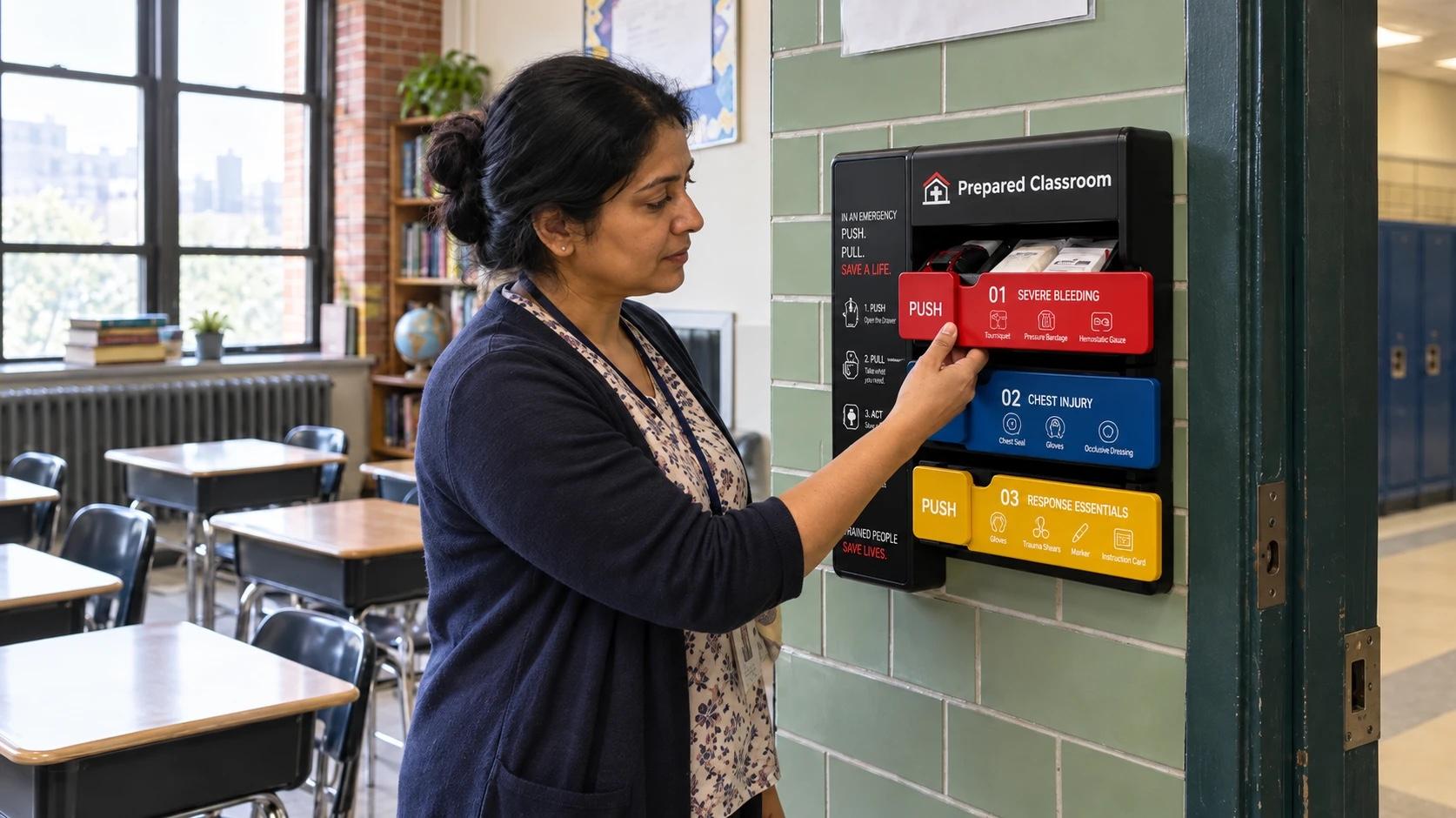
This is the gap that Prepared Classroom exists to close.
What Can Be Done
The solution is straightforward:
- Equipment: Place a compact trauma kit (tourniquet, hemostatic dressing, chest seal) in every classroom — the same way we place fire extinguishers on every floor.
- Training: Give teachers 2 hours of hands-on instruction in hemorrhage control and chest seal application.
- Technology: Use IoT sensors to automatically alert EMS when a kit is opened, with the exact location in the building.
This is not experimental. This is proven combat medicine adapted for schools. The kit uses commercially available, FDA-cleared devices commonly used in military and civilian trauma care. The training is aligned with the American College of Surgeons' Stop the Bleed campaign. And the cost is a fraction of what schools already spend on safety.
The Bottom Line
Most deaths in school shootings are not caused by the severity of the injury. They are caused by the delay in medical care. This is a structural gap in how we prepare for emergencies — and it is fixable.
The question is not whether we can save these lives. The question is whether we will.