
Illustrative image
How a Tourniquet Saves a Life in Under 60 Seconds
The Most Important 60 Seconds
When a major blood vessel in an arm or leg is severed, a person can bleed to death in three to five minutes. The human body contains roughly five liters of blood — about 1.3 gallons. A significant wound to an extremity can cause a person to lose enough blood to go into irreversible shock in a matter of minutes.
A tourniquet stops this. Applied correctly, a tourniquet compresses the blood vessels in a limb and halts life-threatening bleeding in under 60 seconds. It is the single most impactful intervention available for traumatic hemorrhage — and it addresses 60% of all preventable trauma deaths.
What Is a Tourniquet?
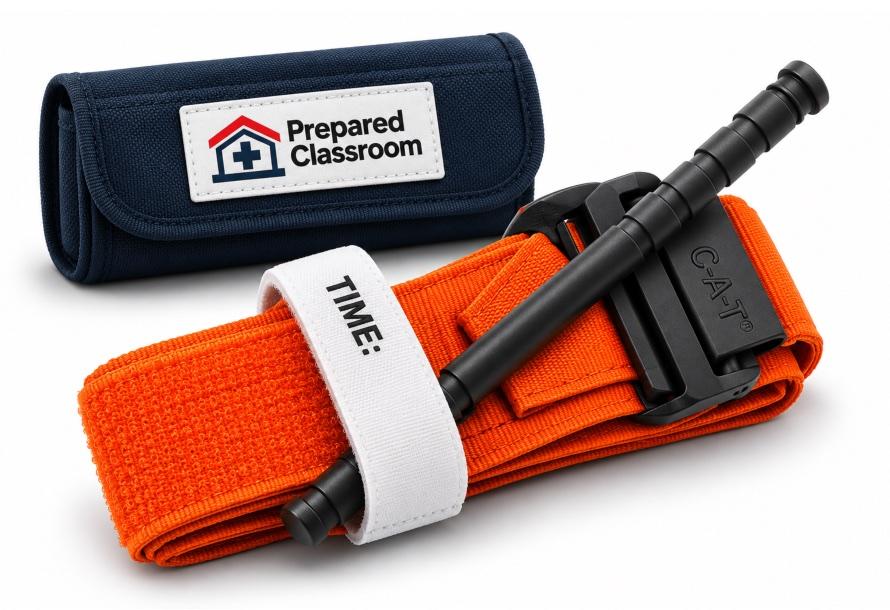
A modern tourniquet — specifically, the Combat Application Tourniquet (C-A-T) — is a strap-and-windlass device. It consists of:
- A nylon strap that wraps around the limb
- A windlass rod (a small bar) that twists to tighten the strap
- A clip that secures the windlass in place
That's it. No batteries. No electronics. No moving parts that can fail. It is an elegantly simple device that has been refined over two decades of military use.
How It Works
The principle behind a tourniquet is straightforward: apply enough external pressure to compress the blood vessels in a limb, stopping blood flow past the point of application.
Here is what application looks like:
- Place the tourniquet high and tight on the injured limb — as high on the arm or leg as possible, above the wound.
- Pull the strap tight through the buckle.
- Twist the windlass rod until bleeding stops. This typically takes 2–3 full turns.
- Secure the windlass in the clip so it doesn't unwind.
- Note the time of application with a marker on the tourniquet or the patient's skin.
Total time: approximately 30 seconds with training. Even first-time users, with basic instruction, can apply a tourniquet in under a minute.
The Military Track Record
The C-A-T tourniquet has been standard issue for U.S. military personnel since the early 2000s. Before widespread tourniquet use, extremity hemorrhage was the number one cause of preventable death on the battlefield.
After the military implemented TCCC (Tactical Combat Casualty Care) and trained all personnel — not just medics — in tourniquet application, preventable combat deaths from hemorrhage dropped dramatically. Studies show the mortality rate from extremity hemorrhage fell by more than 85% when tourniquets were applied before the onset of shock.
This is not a marginal improvement. This is a revolution in point-of-injury care.
Myths vs. Reality
Myth: Tourniquets cause limb loss. Reality: Modern research has thoroughly debunked this. A tourniquet can safely remain in place for 2+ hours without significant risk of permanent damage. EMS routinely manages tourniquet patients, and limb loss from properly applied tourniquets is exceedingly rare. The alternative — bleeding to death — is not a preferable outcome.
Myth: Only medical professionals should use tourniquets. Reality: The entire premise of TCCC and Stop the Bleed is that non-medical individuals can and should apply tourniquets. Studies consistently show that lay persons, with brief training, achieve success rates comparable to trained medical professionals.
Myth: Tourniquets are dangerous in the wrong hands. Reality: A tourniquet has to be applied tightly enough to stop arterial bleeding. A loose tourniquet can make bleeding worse, which is why we practice application in the training.
Civilian Adoption
The American College of Surgeons launched the Stop the Bleed campaign in 2015, following the Hartford Consensus recommendations. The campaign has trained more than 5 million people in hemorrhage control, with tourniquet application as the centerpiece skill.
Stop the Bleed training data shows:
- Lay persons can learn effective tourniquet application in a single training session
- Skill retention is high, especially with annual refresher training
- Complication rates from civilian tourniquet use are low and manageable by EMS upon arrival
Why Tourniquets Belong in Schools
Consider the logic:
- We put fire extinguishers in schools because a fire in a classroom can be deadly, and we want someone to act before the fire department arrives.
- We put AEDs in schools because cardiac arrest is time-sensitive, and we want someone to act before paramedics arrive.
- But for traumatic bleeding — which kills faster than either fire or cardiac arrest and is the leading cause of preventable death in mass casualty events — we put nothing in schools.
A tourniquet costs roughly $30. It weighs a few ounces. It requires no power, no maintenance, and no special storage. It has a shelf life of several years. And in the hands of a trained teacher, it can stop a child from bleeding to death in the time it takes to tie a shoe.
The question is not whether tourniquets work. The evidence is overwhelming. The question is why they aren't in every classroom in America.
The Prepared Classroom Approach
Every CARE Kit from Prepared Classroom includes a Combat Application Tourniquet alongside hemostatic gauze and a chest seal. Our 2-hour training program teaches educators to apply each item confidently and correctly.
Because in those critical minutes between injury and EMS arrival, the person in the room is the person who saves the life. And a tourniquet is how they do it.